
How to build an AI investment analyst with Sai
An AI investment analyst handles the research side of venture work: sourcing founders, logging deal flow, first-pass diligence, memos and portfolio updates. This guide builds one with Sai, step by step, using LinkedIn, X, Crunchbase and Google Workspace accounts you already have, with every email to a founder or reference waiting for your approval.
Tools: LinkedIn, X, Crunchbase, Gmail, Google Sheets, Google Docs
TL;DR: the AI investment analyst you end up with
By the end of this guide you have an AI investment analyst that keeps your pipeline full and your partner meeting prepared, on its own cloud computer, while every decision and every founder conversation stays with you. It runs six routines:
- Founder sourcing. Every Monday, finds founders who just started something in your thesis on LinkedIn, X and Crunchbase, scores them and adds the best to Pipeline.
- Deal-flow triage. Every evening, logs new pitch emails in the Pipeline sheet, files decks in Drive and drafts a meeting request or a polite pass.
- First-pass diligence. On request, reads the data room, checks the team and market, and drafts a first-call memo in your template.
- Reference calls. Finds people who worked with the founders and drafts the outreach, for you to approve.
- Portfolio updates. On the 5th of each month, collects metrics from founder updates into one sheet and chases the late ones.
- Partner meeting prep. Every Sunday, writes a one-page summary of new deals, open diligence and portfolio changes.
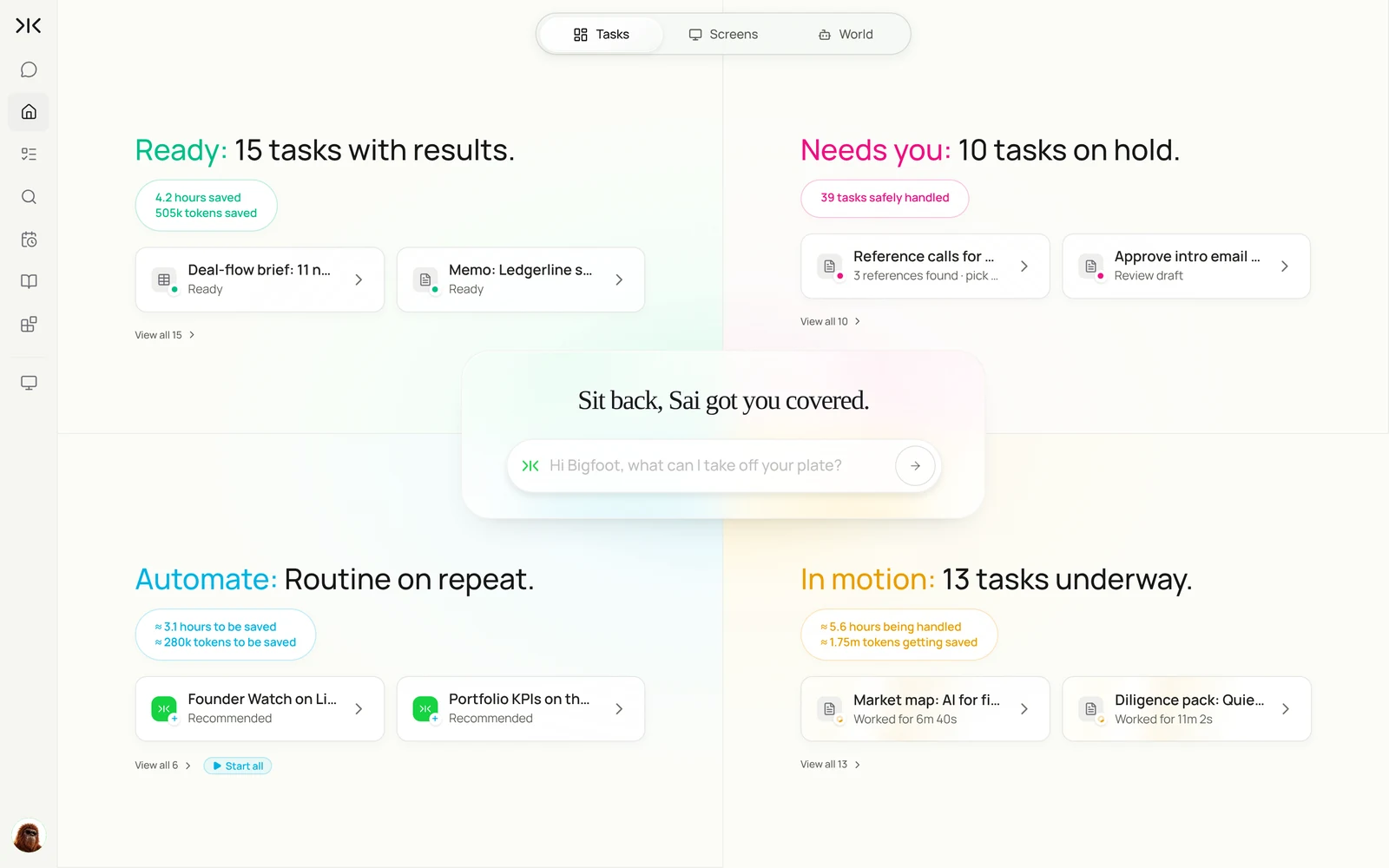
What is an AI investment analyst?
An AI investment analyst is software that does the research and coordination work of a venture analyst or associate: sourcing, screening, diligence prep, memo drafts and portfolio tracking. It does not make investment decisions. It makes sure the people who do have better information, sooner.
Sai is a good fit because most of this work happens in tools without a clean API: LinkedIn and X profiles, Crunchbase and PitchBook screens behind your login, data rooms in Drive or DocSend, and a lot of email. Sai works in those the way an analyst would, on its own computer, and writes the results into your sheets and docs. If your fund tracks deal flow in a CRM, see Sai × HubSpot.
What your AI investment analyst will do
Each workflow below becomes one routine. Set them up in order; each one takes 10 to 20 minutes.
| Workflow | What Sai does | Cadence | Needs your approval |
|---|---|---|---|
| Founder sourcing | Searches LinkedIn, X and Crunchbase, scores against your thesis, adds to Pipeline | Mondays 7:00 | No, it only reads and logs |
| Deal-flow triage | Logs pitches, files decks, drafts a meeting request or a pass | Daily 19:00 | Yes, before any reply |
| First-pass diligence | Reads the data room, checks team, market and competitors, drafts the memo | On request | No, it is a draft |
| Reference calls | Finds people who worked with the founders, drafts the outreach | On request | Yes, before any message |
| Portfolio updates | Collects monthly metrics, chases late updates, flags big moves | 5th of the month | Yes, before reminders |
| Partner meeting prep | Summarizes new deals, open diligence and portfolio changes | Sundays 18:00 | No, it is a summary |
What you need before you start
- A Sai account. The Free plan includes one cloud computer, enough to build and test each step. Daily routines run best on Pro. See Plans, usage, and limits.
- Your thesis, written down. Sectors, stages, check size, geographies, founder backgrounds you like, and companies to skip.
- Accounts Sai will use. LinkedIn, X and any data source you are licensed for, such as Crunchbase or PitchBook, signed in on the cloud computer through Sai’s approval link. Gmail, Calendar and Drive connected in Abilities → Integrations.
- A Pipeline sheet and a memo template in Google Drive, so every output lands where your partners already look.
Step 1: Write your Investment Thesis skill
Everything your analyst does depends on what you look for. Put it in one skill, and every routine below reads it before it acts.
When to use it
Any time you source, screen, score or write about a company or founder.

What we invest in
- Pre-seed and seed, $500K to $2M first checks.
- Fintech infrastructure, developer tools, vertical AI.
- US, UK and Canada.

Founders we like
- Shipped infrastructure at scale before. Technical CEO or CTO.
- Early proof: waitlist, design partners, paying pilots.

Scoring (1-5)
5 = thesis fit + strong team + early traction. 1 = outside thesis.

Rules
- Link every fact to its source. Never guess revenue.
- Never email a founder, reference or LP without my OK.
Save corrections back into the skill as you go: when you pass on a company Sai scored 5, tell it why.
Step 2: Source founders every Monday
Most founders are visible before they are in any database: a new LinkedIn headline, a launch post on X, a first hire. Sai checks all three and Crunchbase in one task.
Every Monday at 7:00, find founders who started a company in the last 90 days
in fintech infrastructure, developer tools or vertical AI.
Check LinkedIn, X and Crunchbase. Score each one with my Investment Thesis skill.
Add the top 15 to the Pipeline sheet with name, company, stage, score, why, and source links.
Skip anyone already in Pipeline. Read at most 60 profiles.
Every Monday, find founders who started a company in the last 90 days in fintech infrastructure, developer tools or vertical AI. Check LinkedIn, X and Crunchbase, score each against my Investment Thesis skill, and add the top 15 to the Pipeline sheet.
- 48 people who started something in 90 days
- 31 with launch, waitlist or hiring posts
- 9 already raised, 39 not yet
- 15 rows added with sources
Related: Sai × LinkedIn and Sai × X cover each source in more depth.
Step 3: Triage deal flow and set your brief
Pitches arrive by email, forms and intros. Sai logs each one, files the deck and drafts a reply, and asks you the questions only you can answer, such as which sectors belong in your daily brief.
Every evening at 19:00, read new pitch emails and intro threads in Gmail.
Add each company to Pipeline: stage, round, sector, location, one-line summary, who introduced it.
Save the deck to Drive under /Deal Flow/<Company>.
Draft a meeting request for score 4-5 and a short, kind pass for the rest. Do not send.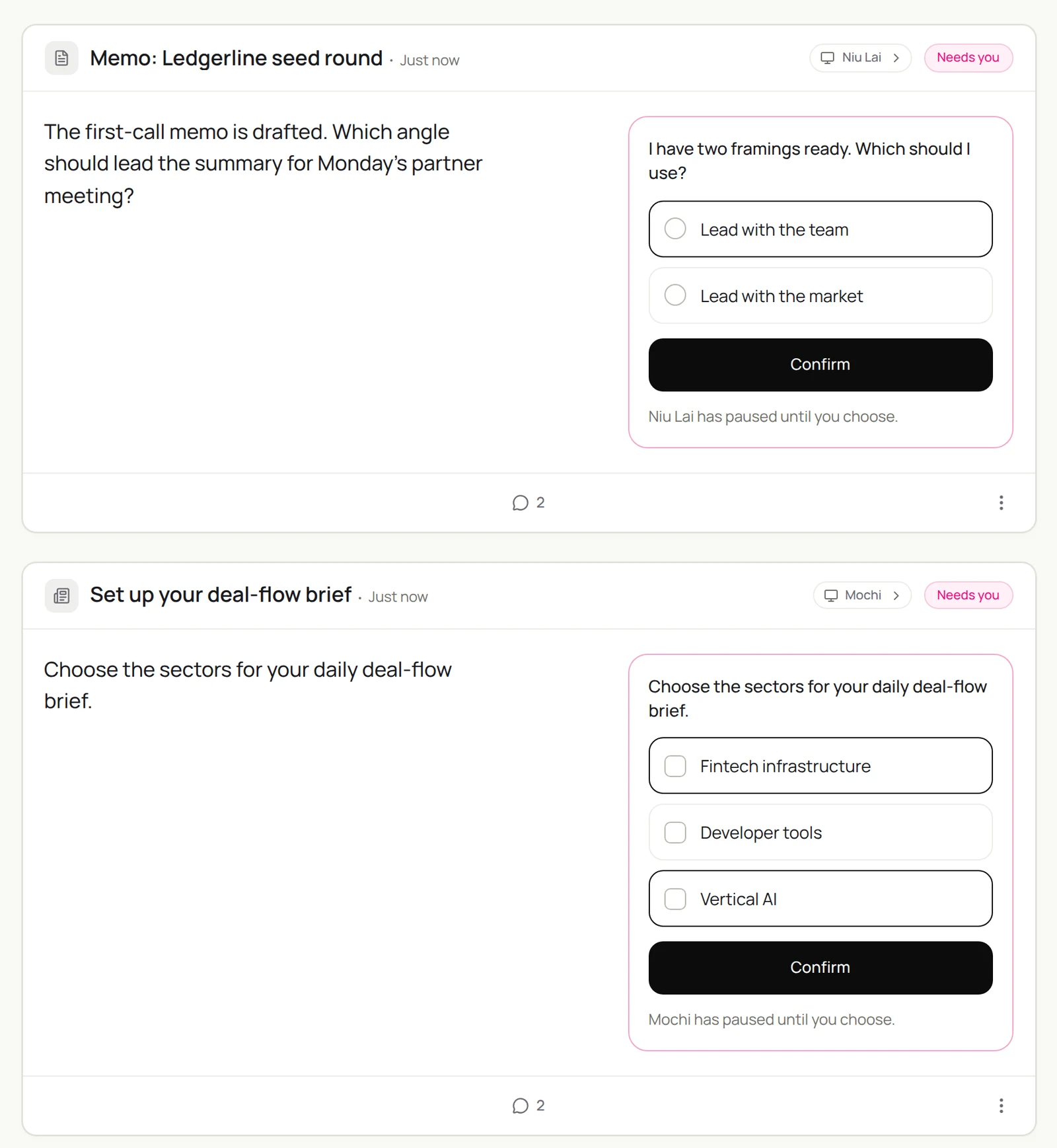
Step 4: Run first-pass diligence
When a deal moves forward, Sai reads the data room, checks the founders and market, and drafts the memo in your template, with every number linked to where it came from.
Ledgerline shared their data room in Drive.
Read the deck, model, cap table and customer contracts.
Check the founders' backgrounds, six closest competitors and recent rounds in the space.
Draft a first-call memo in our template with sources for every number,
and list anything that doesn't match between documents as open questions.
Ledgerline shared their data room. Read everything, check the founders and competitors, draft a first-call memo in our template, and find two people who worked with the CEO for reference calls.
- Deck, model, cap table, 3 customer contracts
- 6 competitors, 2 recent rounds
- 4-page memo with 23 sources
- 4 possible references, waiting for you
Step 5: Line up reference calls
Sai finds people who worked with the founders and drafts a short, specific note. You choose who to contact.
Find four people on LinkedIn who worked directly with Ledgerline's CEO in the last 6 years,
ideally managers or peers, not investors.
For each: name, role, overlap, mutual connections, and a two-line outreach draft.
Do not send anything.
Step 6: Collect portfolio updates
Portfolio reporting is mostly chasing. Sai reads founder updates, fills the metrics sheet and drafts friendly reminders.
On the 5th of every month, find this month's update email from each company in the Portfolio sheet.
Copy revenue, burn, runway and headcount into this month's columns.
Draft a reminder for companies with no update yet.
Flag anything that moved more than 20% since last month.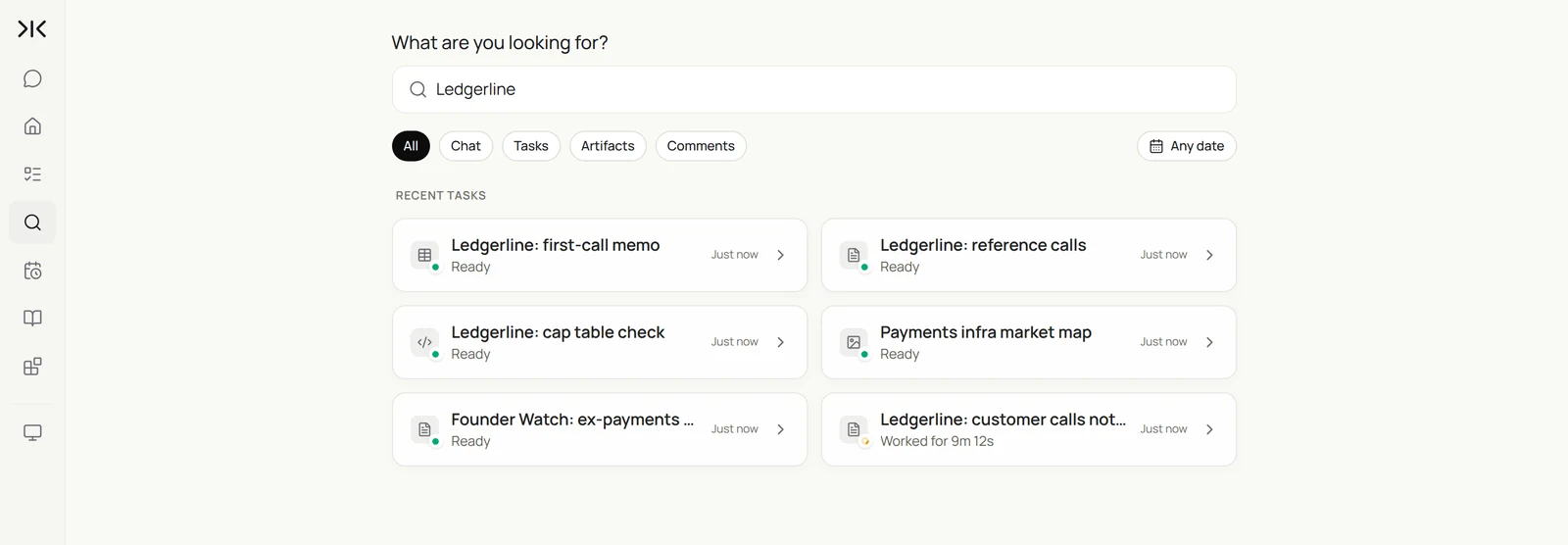
Every memo, brief and update is searchable later. Search finds them by company name across chats, tasks and files.
Step 7: Put your AI investment analyst on a schedule
Turn each task into a routine once it has run well by hand. Your week then looks like this:
| Routine | When it runs | What you do |
|---|---|---|
| Founder sourcing | Mondays 7:00 | Skim the new rows, mark who to meet |
| Deal-flow triage | Daily 19:00 | Approve replies in one pass |
| Portfolio updates | 5th of the month | Approve reminders, read the flags |
| Partner meeting prep | Sundays 18:00 | Read one page before Monday |
Turn on Code-Replay for the routines that repeat the same searches. See Routines.
Keep your AI investment analyst safe
- Decisions stay with you. Sai scores and summarizes. Investment decisions, term sheets and founder conversations are yours.
- Approve every outbound message. Replies to founders, reference outreach and LP emails wait for your OK.
- Use data sources you are licensed for. Crunchbase, PitchBook and similar tools are used only through your own seat, at a human pace.
- Keep confidential material contained. Point Sai to specific Drive folders for data rooms, and tell it never to share files outside the firm.
- Check the sources. Every number in a memo links to where it came from, so a partner can verify it in seconds.
Why build your AI investment analyst on Sai
It works where deal flow actually lives. LinkedIn, X, Crunchbase, data rooms and email have no shared API. Sai uses each of them like an analyst would and writes the results into your sheets.
It gets cheaper as it repeats. With Code-Replay, the Monday sourcing run replays as code once it has worked, so it costs less every week.
It learns your thesis. Every pass you explain is saved into the skill, so the scores get closer to how your partners think.
It finishes the task. Sai ranks #1 on OSWorld, the public benchmark for agents completing real work on a real computer.
Frequently asked questions
What is an AI investment analyst?
An AI investment analyst is software that does the research work of a venture analyst: sourcing founders, logging deal flow, first-pass diligence, memo drafts and portfolio tracking. It supports investment decisions; it does not make them.
Can Sai source founders for a VC fund?
Yes. With your thesis in a skill, Sai searches LinkedIn, X and Crunchbase for founders who recently started something, scores each against your thesis, and adds the best to your pipeline sheet with source links.
Can Sai do due diligence?
Sai can do first-pass diligence: read a data room, check the founders, market and competitors, and draft a memo with sources and open questions. Partners still do the judgment calls and the conversations.
Does Sai work with Crunchbase and PitchBook?
Yes, through your own login in a browser on Sai’s computer. Use only the data sources your fund is licensed for.
Will Sai email founders without asking?
No. In this setup every reply, reference request and reminder is a draft until you approve it.
Can Sai track portfolio companies?
Yes. Sai can collect monthly metrics from founder updates into one sheet, chase late updates, and watch LinkedIn and X for hiring, launches and leadership changes.
Is my deal data safe with Sai?
Sai works only in the accounts and folders you give it, asks before sending or sharing, and you can point it to specific Drive folders for confidential material.
How much does it cost?
You can build and test every step on the Free plan, which includes a daily allotment of computer time. Daily routines usually need Pro at $50 a month. See Plans, usage, and limits.
Related guides
Keep building on the same pieces.